- This event has passed.
Howard W. French at Harvard Book Store presenting The Second Emancipation: Nkrumah, Pan-Africanism, and Global Blackness at High Tide
August 27, 2025 @ 7:00 pm
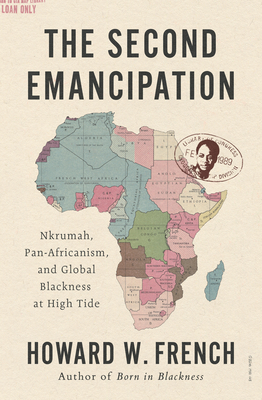
Harvard Book Store welcomes Howard W. French—author of six books, including Born in Blackness, professor of journalism at Columbia University, and a former New York Times bureau chief—for a discussion of his new book The Second Emancipation: Nkrumah, Pan-Africanism, and Global Blackness at High Tide.
About The Second Emancipation
Named one of the Most Anticipated Books of 2025 by Foreign Policy
From the acclaimed author of Born in Blackness comes an extraordinary account of Africa’s liberation from colonial oppression, a work that fundamentally reshapes our understanding of modern history.
A work of epic dimension that recasts the liberation of twentieth-century Africa through the lens of revolutionary leader Kwame Nkrumah.
The Second Emancipation, the second work in a trilogy from best-selling author Howard W. French about Africa’s pivotal role in shaping world history, underscores Adam Hochschild’s contention that French is a “modern-day Copernicus.” The title—referring to a brief period beginning in 1957 when dozens of African colonies gained their freedom—positions this liberation at the center of a “movement of global Blackness,” with one charismatic leader, Kwame Nkrumah (1909–1972), at its head.
That so few people today know about Nkrumah is an omission that French demonstrates is “typical of our deliberate neglect of Africa’s enormous role in the birth of the modern world.” Determined to re-create Nkrumah’s life as “an epic twentieth-century story,” The Second Emancipation begins with his impoverished, unheralded birth in the far-western region of Ghana’s Gold Coast. But blessed with a deep curiosity, a young Nkrumah pursued an overseas education in the United States. Nowhere is French’s consummate style more vivid than in Nkrumah’s early years in Depression-era America, especially in his mesmerizing portrait of a culturally effervescent Harlem that Nkrumah encountered in 1935 before heading to college. During his student years in Pennsylvania and later as an activist in London, Nkrumah became steeped in a renowned international Black intellectual milieu—including Du Bois, Garvey, Fanon, Padmore, and C.L.R. James, who called him “one of the greatest political leaders of our century”—and formed an ideology that readied him for an extraordinarily swift and peaceful rise to power upon his return to Ghana in 1947.